
Librarian for a Day
A day amidst the stacks shows the fine line school librarians walk

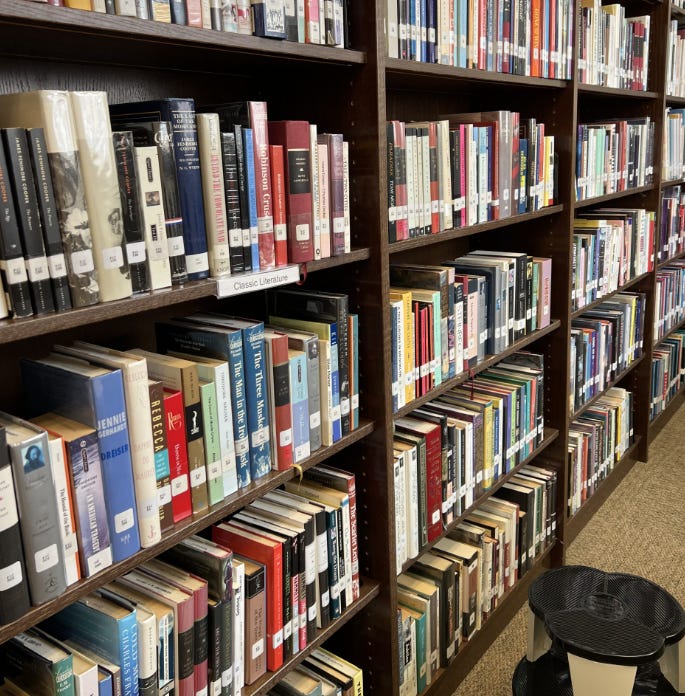
It was a day amongst the stacks (American Library Association)
It’s a double-edged sword. We want teenagers to be off their screens, but schools require that most things are done digitally. A high school librarian has to walk a fine line to promote reading in a world of digital domination. It is a tough battle against phone addiction, while most assignments are done on Google Classroom. I witnessed this challenge first hand as my occasional retirement job (an oxymoron) as a substitute teacher brought me into our school’s library. It was about more than just telling kids to be quiet. It was a day in a safe and creative space that promoted literacy and non-digital uses of the mind. Libraries are alive and well in an age where everything we do seems to be done online.
In the years since my retirement from a long career in education, I have been working as a substitute teacher for just a few days each month. It gets me out of the house and lets me be among students and my old teacher friends. I have been in every part of the building, covering classes in every subject area. Recently, though, I had my first day subbing for our school’s excellent librarian. It certainly raised my awareness of the challenges schools face in the battle against phone addiction.
In this first year of New York State’s complete school day ban on cell phones, enforcing that policy is one of the first jobs of people supervising students. One of the key tasks of libraries under these new conditions is to create a refuge from screens and social media. This means that the library needs to become more than just a place to read books and study. This school’s librarian has created an amazing non-traditional space for all manner of mental stimulation without the need for a phone in one’s hand. It was a revelation to see students playing chess and grabbing board games at the start of a period. There was a jigsaw puzzle for students to collaborate on all day long, with completed puzzles hanging on the wall as art. There were kids doing plastic bead art, creating their own comic book “zines,” and a table labeled as a “maker’s space” for all types of collaborative creations. It seemed like the purpose of this part of the building was to allow kids to celebrate the mind without the toxicity of social media. This place was about more than books. Kids could be reminded that there is life beyond doom scrolling.
In between the book stacks at the end of each row were floor level recliners and bean bag chairs. Every period each one was occupied by a teenager with their nose in a book. I had not allowed myself to think that this was still possible in the 21st century. In the center of the space were rows of tables where students could work together. There were “mostly productive” collaborations going on there, with kids studying for the AP exams that were set to begin the next week.
Beyond the shhh!
I don’t want to paint a picture that shows only studious little angels. These were high school kids, so of course there was chatting and socialization that at times rose above appropriate library noise levels. There were some less than serious kids whose antics called for reminders that perhaps they would better spend their energy in the cafeteria. This was especially true of midday periods when a large number of students were free for lunch. More often than not, though, students were doing something positive and productive, recognizing that this space was not meant for rowdiness. Yes, I had to ask some students to leave, yet the vast majority were in the library for appropriate reasons.
In the years since covid quarantines called for empty schools and remote learning, we have learned a great deal about the mental health need of teens to be physically among others, whether they are working together or just silently reading next to someone. I found it heartening to see kids smiling and collaborating. Covid deprivations have reminded us that the small things are important. This library was quietly (and maybe not so quietly) building a sense of community.
In the era of computers, many may have asked about whether we still need libraries as places for “old school” books. Gone are the card catalogs, volumes of Reader’s Guide to Periodical Literature, and vertical files filled with newspaper clippings. The modern librarian in the digital age is now considered a “media specialist.” Their role includes teaching students that serious research involves much more than Google. They educate students about what plagiarism is in the age of cut and paste. Media specialists help scholars who still need to know how to cite their sources. Yet, the primary job of librarians is still to promote literacy. It is cool to see all the posters in this building that urge kids to read, but the chief role of a librarian is to curate a diverse collection that entices students to pick up a book. My favorite sign hanging in this space was near the librarian’s desk. It read: “I’m not a book worm, I’m a book dragon.”
The double-edged sword
The primary job of schools is to create an educated citizenry. This must take place amidst conflicting challenges in our current age. We want students to be literate adults who are not bound by the mind-numbing effects of social media. Yet, at the same time we know that we do function in a digital world where nearly all of our business is conducted on electronic devices. When I finished my teaching career, I was completely paper free. All assignments and assessments were done on a digital platform. This brings the monumental challenge of asking students to function in a digital world while still knowing how to unplug. The library guaranteed that all students have access to meet digital requirements. They had to do this while simultaneously discouraging phone addiction.
Our school’s library recognizes this conundrum. In order for students to complete their assignments, they had to have access to laptops even if they did not have one at home. Our library aides leant out laptops for students to work, while also helping them check out books. It is ironic that laptop access in the library might be a way for students to circumvent the cell phone ban, but there is only so much schools can do in the battle against social media. There are legitimate educational needs for computers, so they were out and in use on the tables. As a teacher, I knew that I could assign digital work (if I gave students enough time) because even if their computer access at home was limited, they had the ability to use one at school or in the public library.
Schools work against the toxic power of screens, while still functioning in a world that requires them. Libraries are at the forefront of this challenge. The best librarians, like the one in my own school, know that libraries must fight both battles. My day as a librarian was enlightening. I found that there is a safe place in the school away from the chaos of the cafeteria. I saw that there is still a place that celebrates creativity and non-digital fun. There is still a place where the wonderment of reading takes a position in front of the enticements of a phone. It can be this place while still giving students access to the legitimate digital needs of education. There is still a place that cares about books. In a TikTok world that means something.
What a great assignment you had! Libraries rule! I have some strong opinions about the digital edge of the sword you spoke about that diminishes social skills and isolates the phone-addicted populace. Reading (from printed books) is becoming a lost art, much to my dismay. This dinosaur received an anxiously anticipated order from Thriftbooks stuffed with some great summer reading material. Color me happy.
I appreciate your "two-edged sword" comment, Paul. I'm not on social media BUT I use my phone to read newspapers; in my case, I have apps for The New York Times, The Guardian, and Le Monde. On a bad day, I can spend too much time with eye-strain as a result. It definitely CAN take away from my book reading, especially if I transition from newspapers and start bouncing around Wikipedia links.